The Truckee River Revitalization: What Reno Isn't Telling You About the 2026 Restoration
By Ask Reno
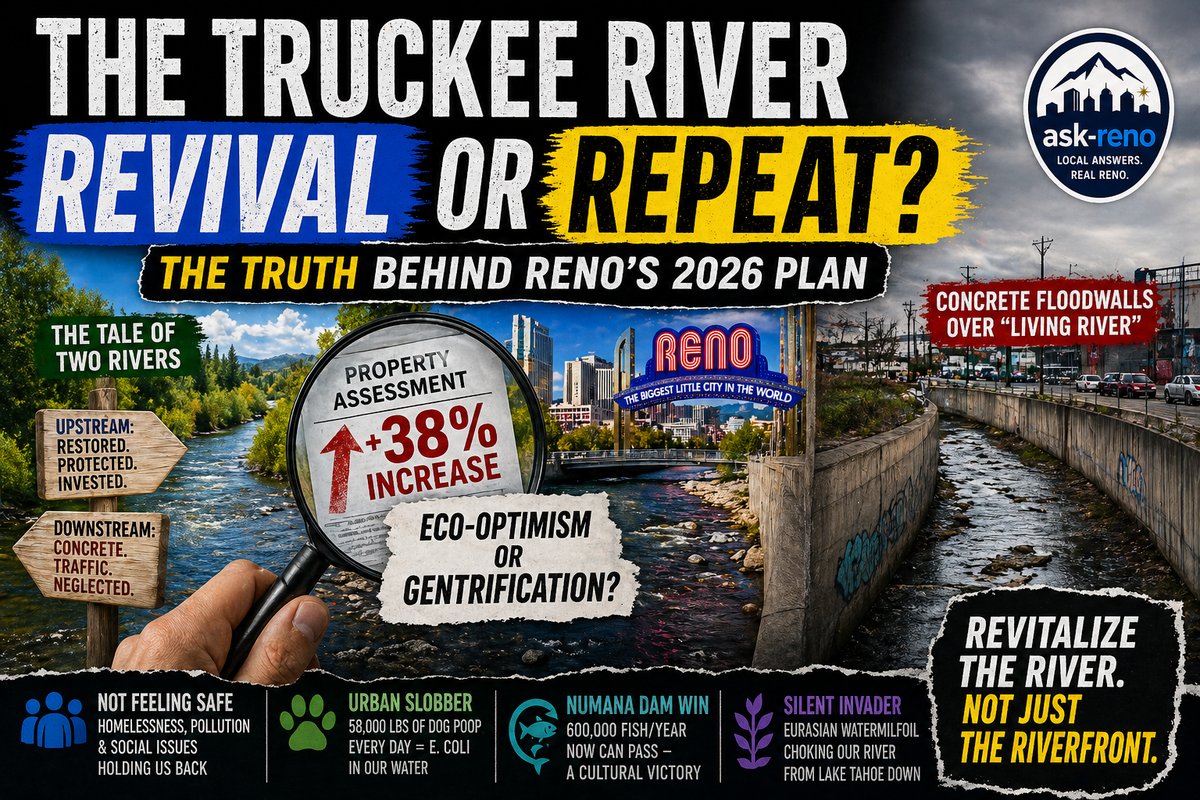
Reno's selling the Truckee River revitalization as a win. New paths. Cleaner banks. Better flood protection. Restored fish habitat. The city's PR team has a phrase for it: eco-optimism.
If you actually live here, you might have a different word for it.
Because the closer you look at the 2026 Truckee River Restoration Project — the budgets, the displaced renters, the watered-down "Living River" plan, the parts of the river that locals literally won't walk on after dark — the more it starts to feel like the same old Reno story dressed up in green packaging. Some of it is genuinely hopeful. Some of it is gentrification with a coat of varnish. And some of the most important wins (and worst losses) aren't in any press release.
Here's what's actually happening on the Truckee in 2026 — pulled from One Truckee River's own community surveys, public TRFMA documents, and what locals are saying when the cameras aren't rolling.
Get Reno's best picks weekly
Plus exclusive subscriber offers from eligible local businesses
The "Eco-Optimism" Trojan Horse
The official line is that revitalizing the Truckee corridor benefits everyone. New trails, restored riparian zones, updated flood maps. Who could argue with that?
Renters in Sparks and east Reno can.
Updated FEMA flood maps and the new amenity layer along the river are pushing property assessments through the roof. That's good news if you own. It's a quiet eviction notice if you rent. And the pattern is so visible that even upstream — in the Town of Truckee — the city has had to publicly reassure riverfront business owners that they will not be forced to relocate as part of the new "R3 Playbook" revitalization.
The unspoken question among locals: Is this growth actually serving the people who live here, or is it serving developers who'll cash out before the lawsuits land?
How "Living River" Quietly Died
You probably don't remember this, but in 1997 a New Year's flood on the Truckee did over $1 billion in damage to northern Nevada. Sparks ate most of it.
Out of that came a community vision: the Living River plan. Setback levees. Restored meanders. Wetlands. A river that handled flood water the way nature designed it to — slowly, with vegetation, across a wider corridor. It was endorsed by environmentalists, fishermen, and most of Sparks.
Then it didn't happen.
What killed it: a decade of dithering from the U.S. Army Corps of Engineers, a tax base hollowed out by the Great Recession, and a decision by the Truckee River Flood Management Authority (TRFMA) to scale the project down to whatever was politically affordable. The setback levees got cut. The recreation features got cut. The native plantings got cut. What survived?
Concrete floodwalls and channelization. The same approach the Living River plan was supposed to replace.
If you've ever driven past the I-580 bridge and wondered why the "restored" stretch of river looks more like a drainage ditch — that's why. We chose cheaper.
A Tale of Two Rivers: Truckee vs. Sparks
Walk the river in Truckee, California. You'll find buffered "Legacy Trails" hiding industrial uses behind native vegetation. Land trusts and nonprofits have poured millions into wetland restoration. There's actual shade.
Now walk the river path in Sparks. The vegetation buffer is mostly gone. You're exposed to East 4th Street traffic, an auto wrecking yard, the freeway, and the smell of a hot August afternoon on baking concrete.
Same river. Two completely different priorities. One Truckee River — the nonprofit that's been studying the corridor for years — has called it an "embarrassment of indifference" in the Truckee Meadows compared to what the Sierra side has accomplished.
It's not a money problem. It's a values problem.
The Elephant Nobody Wants in the Press Release
Ask any local what they think of the river and the conversation goes the same place within 30 seconds. It's not safe.
One Truckee River's own community survey came back with the same answer over and over: people don't feel comfortable spending time along the urban stretches of the Truckee. The reasons named most often:
- The visible homeless population along the corridor
- Open substance use
- Mental health crises happening in plain view
- Pollution, broken glass, and unattended waste
This is the part of the conversation Reno's tourism office doesn't want to have. But in the survey responses, locals are blunt: revitalizing the river physically while ignoring the social crisis is moving the deck chairs. You can't tell people to go enjoy the trail and then look surprised when they don't.
The most-quoted line from a survey response: "Fix the people problem first. The river will follow."
Things You Probably Didn't Know
A few details that didn't make the press kit:
Renters dispose of hazardous waste better than homeowners
A local watershed survey turned up something nobody expected: in Reno, renters are statistically more likely than homeowners to properly drop off oil, antifreeze, and batteries at hazardous waste collection sites. The narrative that renters don't care about the river is just wrong.
Dog poop is the third-biggest pollutant in the Truckee
Washoe County has an estimated 116,000 dogs producing roughly 58,000 pounds of waste every single day. E. coli from pet waste — locally called "urban slobber" — is now the third-largest pollutant in stretches of the Truckee. Not industrial runoff. Not casino wastewater. Pet waste, washing into storm drains and downstream into our drinking water.
Pick it up. Seriously. The river you swim in is the same river you drink from.
The biggest cultural win is happening 30 miles east of town
While urban Reno argues about floodwalls, Numana Dam — about 30 miles east on Pyramid Lake Paiute Tribe land — is being modified for fish passage with $8 million in Bipartisan Infrastructure Law funding. The end result: up to 600,000 Cui-ui sucker fish and Lahontan cutthroat trout will be able to pass the dam annually, restoring a fishery that's been a cultural cornerstone of the Pyramid Lake Paiute Tribe for thousands of years.
You won't see this in a Reno tourism ad. But it's the most consequential river story of 2026.
The silent invader
Eurasian watermilfoil — an aggressive invasive aquatic plant — has been quietly spreading down the Truckee from Lake Tahoe. It chokes out native fish habitat and physically tangles up rafts, paddleboards, and tubes. The state has been slow to respond. If you tube the river this summer and feel something grabbing at your legs, that's it.
So What Does "Locals Say" Actually Look Like?
Pull all of this together and a few patterns emerge:
1. Locals support river restoration. The survey data is overwhelming on this. 2. Locals do not trust that the current plan is the right one. Concrete floodwalls don't match what the community asked for. 3. The social conditions along the urban corridor are the #1 barrier to using the river. Not parking. Not signage. Not amenities. 4. The most meaningful wins are happening outside the city limits — Numana Dam, upstream wetland projects, tribal-led restoration. 5. The aesthetics-first revitalization narrative is being received as developer marketing. People can tell the difference between a real restoration and a rebrand.
The Bottom Line
Reno is going to build more river paths. The PR is going to keep calling it eco-optimism. New restaurants will open. Property values will keep climbing. Some of that is good for the city.
But the actual story of the Truckee in 2026 isn't about new lighting on the riverwalk. It's about who gets pushed out when the assessments come in. It's about a community vision that got watered down to whatever was cheapest. It's about 600,000 fish finally being able to swim past a dam built before most of us were born. And it's about whether we're willing to talk about the real reason locals avoid the river — instead of just power-washing the symptoms.
The river is the city. Most of what's broken about Reno shows up here first.
What do you think? Hit reply to our weekly newsletter or drop a comment on r/Reno and tell us what you're actually seeing on your stretch of the river.
Sources & Further Reading
- One Truckee River — community survey & watershed data
- Truckee River Flood Management Authority (TRFMA) — Living River project history
- Pyramid Lake Paiute Tribe & U.S. Bureau of Reclamation — Numana Dam fish passage
- Town of Truckee — R3 Playbook revitalization documentation
- Bipartisan Infrastructure Law — Numana Dam grant ($8M)
Enjoyed this? Pass it on.